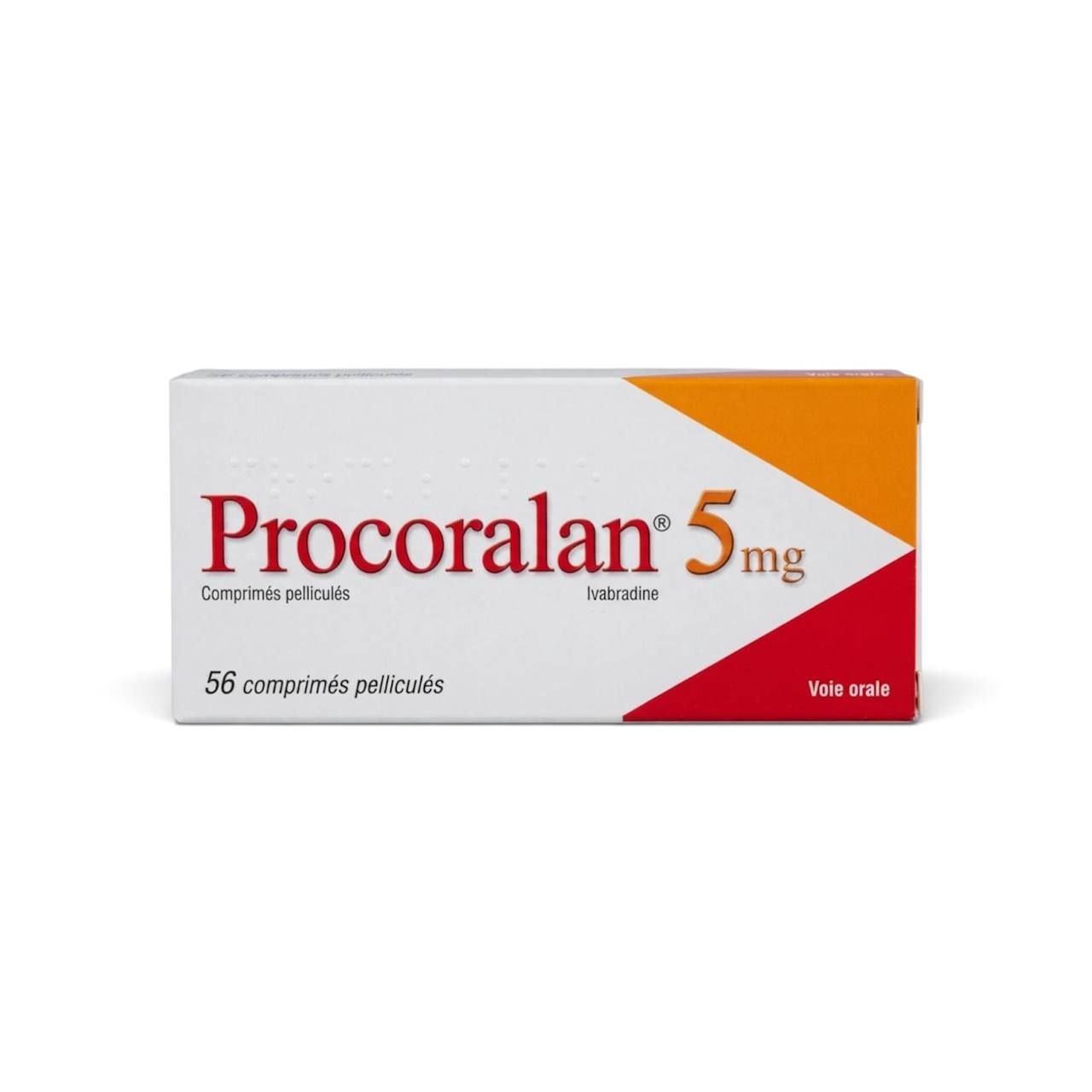
Procoralan 5 mg (Ivabradine) 56 Tablets
67,00 €
Ivabradine
In stock
Save this product for later
Customer reviews
Reviews only from verified customers
No reviews yet. You can buy this product and be the first to leave a review.
Procoralan 5 mg (Ivabradine) 56 Tablets
Product Details
Procoralan 5 mg (Ivabradine) 56 Film-Coated Tablets — Servier
Procoralan is the heart-rate-lowering medicine with a unique mechanism: it acts exclusively on the If channels of the sinoatrial node — the natural pacemaker of the heart. The result is a slower heart rate with no effect on blood pressure and no effect on heart muscle contractility — the property that distinguishes ivabradine from beta-blockers and made it the reference drug for patients who cannot tolerate or cannot take beta-blockers.
Why the mechanism matters
- Lowers heart rate only — blood pressure and contractility stay untouched (beta-blockers lower all three);
- The natural pacemaker channels — the If ("funny") current controls the heart's own rhythm; ivabradine slows it selectively;
- For beta-blocker-intolerant patients — asthma/COPD patients who cannot take beta-blockers still get rate control;
- Combines with beta-blockers — in heart failure, both together reach deeper rate control than either alone.
What it is used for
- Stable angina — rate control in patients with normal sinus rhythm (beta-blocker intolerance or insufficient control);
- Chronic heart failure — when heart rate stays ≥75 bpm despite optimal beta-blocker therapy;
- Inappropriate sinus tachycardia — off-label, per physician (the go-to option for persistent fast pulse without heart disease);
- Always per physician prescription with heart rate monitoring.
Composition and form
- Active ingredient: ivabradine 5 mg per film-coated tablet (the 7.5 mg twice-daily maintenance step is titrated from here);
- Form: 56 film-coated tablets, oral route — a full month of twice-daily therapy;
- Manufacturer: Servier (Europe) — the discoverer of the molecule.
How it is used
- Standard start: 5 mg twice daily (morning and evening with meals);
- After titration: typically 7.5 mg twice daily per physician;
- Works only in normal sinus rhythm — it does nothing in atrial fibrillation (an ECG before starting is mandatory);
- Effect builds over 2–4 weeks of steady use — not a "pulse pill" for immediate relief;
- Never stop abruptly without physician guidance.
Safety information
- The signature side effect — luminous visual phenomena (phosphenes): temporary brightness in the visual field, usually in the first two months, reversible and dose-dependent — reported by ~1 in 7 users, rarely a reason to stop;
- Not for atrial fibrillation — useless there and risks worsening conduction;
- Sick sinus syndrome, pacemaker-dependent patients — contraindicated or physician-managed;
- Bradycardia (too slow pulse) is the dose-limiting effect — regular pulse checks;
- Pregnancy and breastfeeding — contraindicated;
- Interactions: strong CYP3A4 inhibitors (some antifungals, macrolides) are prohibited combinations — full medicine list to the physician;
- Combination with amiodarone or strong rate-lowering drugs needs careful supervision.
FAQ — Frequently Asked Questions
How is Procoralan different from beta-blockers?
Beta-blockers lower heart rate, blood pressure and contractility together — which is why asthmatics and COPD patients often cannot take them. Ivabradine acts only on the heart's pacemaker channels: rate falls, pressure stays. For angina or heart failure patients who cannot tolerate beta-blockers, this is the decisive advantage. In heart failure the two are combined — beta-blocker for the full effect, ivabradine for the rate that beta-blockers alone cannot reach.
What are the "luminous phenomena" people mention?
Phosphenes — brief sensations of brightness in parts of the visual field, typically in the first two months of therapy, often when moving between light and dark environments. They are reversible, dose-dependent and usually fade with continued use. Reported by around 15% of users, rarely requiring discontinuation. The mechanism relates to the retina's Ih channels — the same channel family the drug targets in the heart. Tell your physician, but do not panic: this is the known signature effect of the molecule, not a sign of damage.
Will it help my fast pulse if I have anxiety or atrial fibrillation?
Only in sinus rhythm — a normal heart rhythm pattern. In atrial fibrillation ivabradine does not work and can worsen conduction. A persistent fast pulse from anxiety/stress with normal sinus rhythm is a common off-label use ("inappropriate sinus tachycardia") — but this is a physician decision after ECG confirmation. The ECG before starting is not a formality — it defines whether the drug can work at all.
How fast does it work and when do I feel the effect?
Heart rate reduction builds over 2–4 weeks of steady twice-daily use — this is a background therapy, not an immediate "slow my pulse" pill. Expect a gradual drop in resting pulse measurable on your home measurements. Never adjust the dose based on one high-reading day; the trend over weeks is what matters.
Can I combine Procoralan with my beta-blocker?
In heart failure — yes, this is a registered combination strategy when the beta-blocker alone cannot bring the pulse below 75 bpm. In angina, combination is also possible per physician. But the combination increases bradycardia risk — the physician starts low and monitors pulse. Never self-combine rate-lowering drugs: slow pulse below 50 bpm is a contact-your-physician-immediately situation.
Ask a question or inquire about delivery to your country
You May Also Like
CRESTOR (Rosuvastatin) 10 mg/20 mg
CRESTOR (Rosuvastatin) 10 mg/20 mg
Lowering cholesterol levels
66,00 €
Display prices in:EUR

