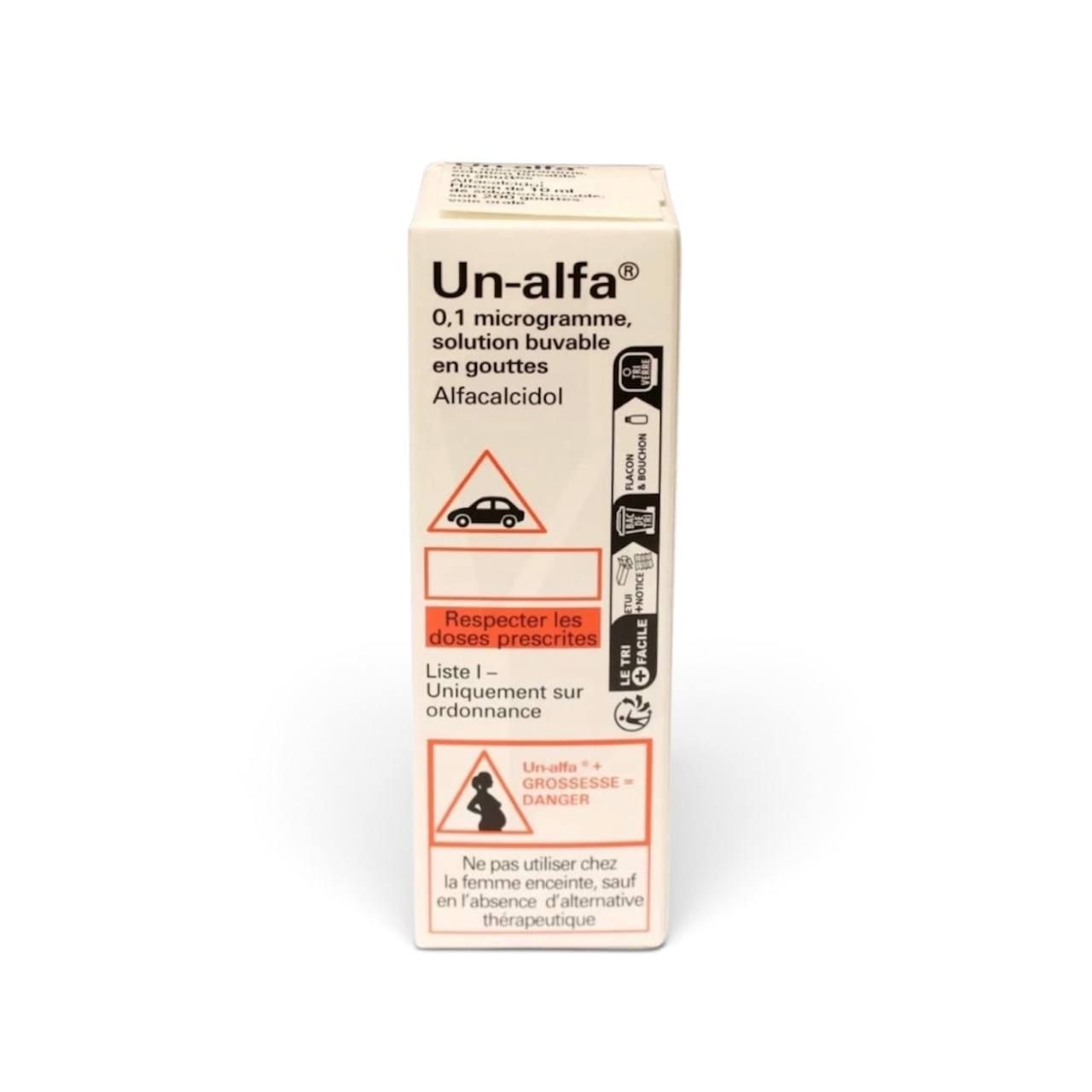
UN-ALFA 0.1 µg Drops (Alfacalcidol) 10 ml
65,00 €
Alfacalcidol
In stock
Save this product for later
Customer reviews
Reviews only from verified customers
No reviews yet. You can buy this product and be the first to leave a review.
UN-ALFA 0.1 µg Drops (Alfacalcidol) 10 ml
Product Details
UN-ALFA 0.1 µg Drops (Alfacalcidol) 10 ml Bottle — Cheplapharm
UN-ALFA oral drops is the liquid form of alfacalcidol — an active vitamin D3 analog that does not require kidney activation. The drop format gives the finest dose control available for this medicine: 1 drop = 0.1 µg of alfacalcidol, so a physician can titrate the dose to microgram precision — impossible with fixed-strength capsules. This is why the drops form is the preferred choice for infants, children, patients with swallowing difficulties and everyone requiring careful dose adjustment.
Key facts from the official instructions
- Composition: alfacalcidol 0.1 µg per drop; 1 ml = 20 drops = 2 µg; the 10 ml bottle contains 20 µg total (200 drops);
- Excipients worth knowing: contains sorbitol, ethanol, methyl parahydroxybenzoate, castor oil derivative, sodium;
- Storage: refrigerate (2–8°C), protect from light (amber glass bottle), do not freeze; after opening — 4 months shelf life;
- Drop counter: the dropper is built into the bottle neck to prevent mass accidental intake by a child;
- Pregnancy: the pack carries the explicit regulatory warning — do not use during pregnancy unless no therapeutic alternative exists.
Why the drops form is chosen
- Microgram-precision titration — 1 drop = 0.1 µg; dose can be increased by single drops as the physician decides;
- Works for all ages — the only form suitable for infants and small children (neonatal hypocalcemia is a registered indication);
- Solves swallowing problems — drops in a little water or milk;
- Same molecule as the capsules — active vitamin D analog that skips the kidney activation step of ordinary vitamin D3.
What it is used for
UN-ALFA drops is a prescription medicine (List I) used for:
- renal osteodystrophy and secondary hyperparathyroidism in chronic kidney disease;
- hypoparathyroidism (post-surgical or idiopathic);
- neonatal hypocalcemia (late form) — dose adapted under daily blood calcium monitoring;
- vitamin D deficiency states unresponsive to standard supplementation;
- rickets and osteomalacia of various origins.
How it is used
- Maximum daily doses per instructions: 8 µg/day for adults, 3 µg/day for children (actual dose is always individual, per physician);
- Standard adult start: 0.25 µg/day = 2–3 drops once daily (per prescription);
- Take with a little water or milk;
- Hold the bottle vertically, dropper down; close tightly after use;
- Store in the refrigerator in the original box, never frozen;
- Dose is titrated based on regular blood calcium monitoring — never self-adjusted.
Safety information
- Main risk — hypercalcemia (excess calcium): thirst, nausea, frequent urination, constipation, confusion — report to your physician;
- Contraindicated in hypercalcemia (pre-existing) and hypersensitivity to components;
- Regular blood calcium monitoring is mandatory during therapy;
- Do not combine with high-dose vitamin D3 supplements without physician guidance;
- Caution with thiazide diuretics, cardiac glycosides (digoxin);
- Pregnancy: contraindicated except when no therapeutic alternative exists — explicit physician decision;
- Keep out of reach of children — the built-in dropper is a safety feature, not a toy.
FAQ — Frequently Asked Questions
How is this different from the UN-ALFA capsules?
Same molecule — alfacalcidol. The difference is the dosing format: capsules are fixed-strength (0.25/0.5/1 µg), drops allow any dose in 0.1 µg steps. Drops are the preferred form for children, infants, and patients requiring fine titration; capsules suit adults on stable maintenance doses. Your physician chooses the format based on who is taking it and how precise the titration must be.
Why does it need refrigeration?
Alfacalcidol is a fat-soluble molecule sensitive to light and temperature — the amber glass protects from light, and 2–8°C keeps the solution stable for the full shelf life (36 months unopened, 4 months after opening). Keep it in the original box inside the refrigerator, never in the freezer. If the bottle was left out overnight by accident, it is not automatically spoiled — but a full day at room temperature or higher warrants replacement.
How many drops is a standard dose?
The typical adult start is 0.25 µg/day = 2–3 drops once daily, but the actual dose is always individual and set by your physician based on blood calcium. Remember the conversion: 1 drop = 0.1 µg, 1 ml = 20 drops. Maximum permitted daily doses per instructions: 8 µg (adults), 3 µg (children) — your prescribed dose will be well within these limits.
Can I give it to my infant or child?
Yes — neonatal and childhood hypocalcemia are registered indications for this exact drops form. Pediatric dosing is always physician-managed with daily blood calcium monitoring in neonates. The built-in dropper prevents a child from accidentally drinking the whole bottle — but still store it out of reach and refrigerated.
What happens if calcium levels get too high?
The physician pauses or reduces the dose and rechecks within days — hypercalcemia is reversible when caught on time. Watch for thirst, nausea, frequent urination, constipation, confusion. The blood tests are not a formality: symptoms often appear only after levels have risen significantly. Keep the monitoring schedule.
Ask a question or inquire about delivery to your country
You May Also Like
Display prices in:EUR

