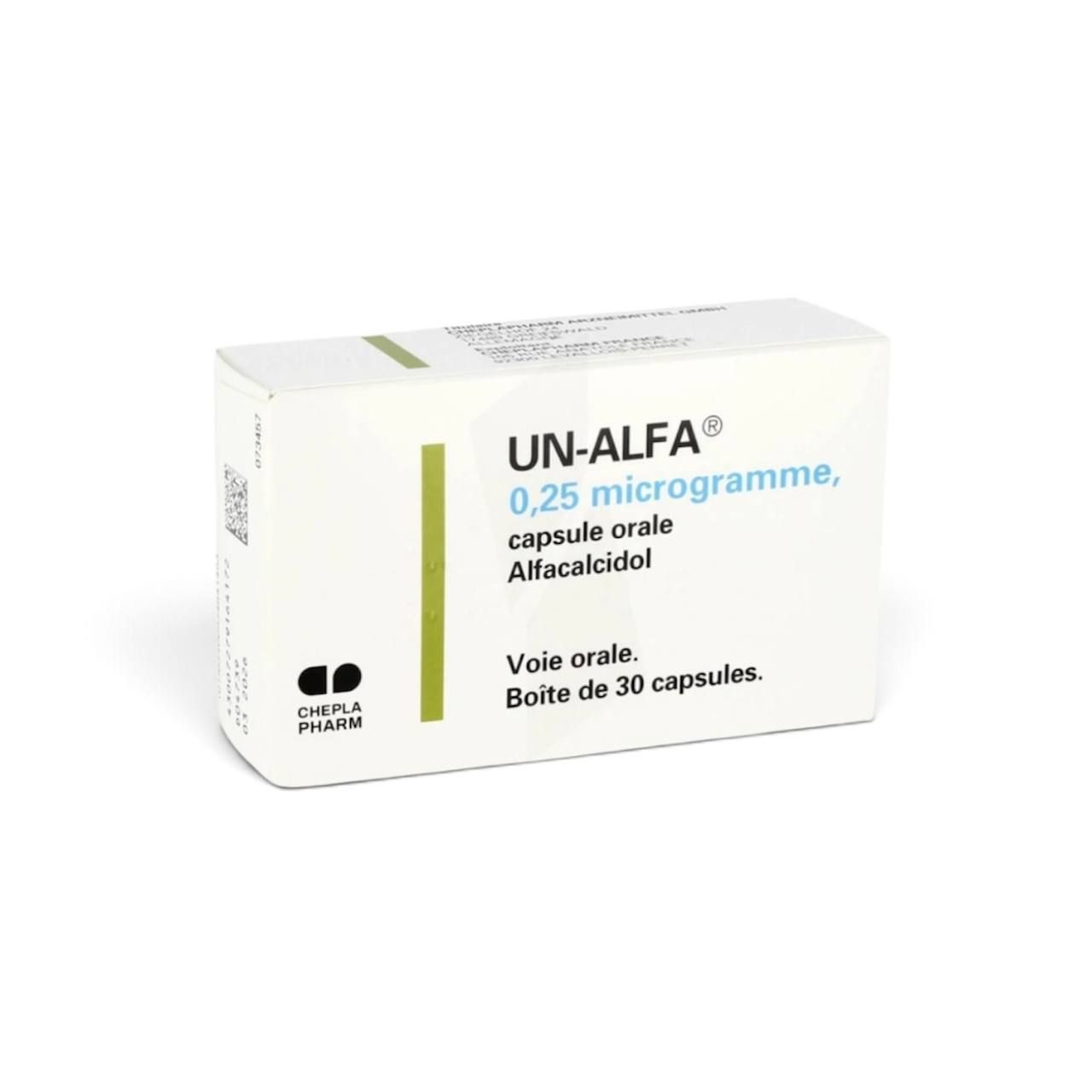
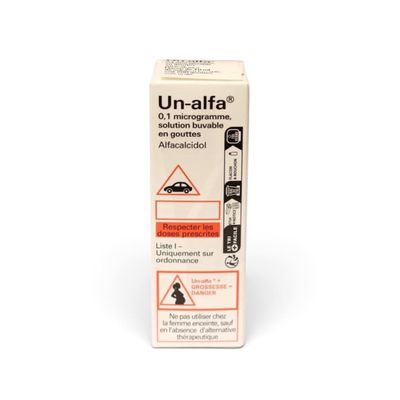
UN-ALFA 0.25/0.5/1 µg (Alfacalcidol) 30 capsules
45,00 €
Dosage
Please choose
Alphacalcidol
In stock
Save this product for later
Customer reviews
Reviews only from verified customers
No reviews yet. You can buy this product and be the first to leave a review.
UN-ALFA 0.25/0.5/1 µg (Alfacalcidol) 30 capsules
Product Details
UN-ALFA 0.25 / 0.5 / 1 µg (Alfacalcidol) 30 Capsules — Chepla Pharm
UN-ALFA is the oral alfacalcidol preparation — an active vitamin D3 analog that does not require kidney activation. Unlike ordinary cholecalciferol (vitamin D3), which the liver and kidneys must convert step by step, alfacalcidol needs only hepatic hydroxylation and therefore works even in patients with impaired kidney function. In European practice it is the reference choice for renal osteodystrophy, hypoparathyroidism, and vitamin D deficiency states where standard vitamin D is insufficient.
Why alfacalcidol is chosen instead of ordinary vitamin D
- Skips the kidney step — works when kidney activation of standard vitamin D3 fails (chronic kidney disease, elderly with reduced renal function);
- Predictable dosing — the active molecule is already "one step away" from the final hormone (calcitriol), so effects are more reproducible;
- Precise strengths — 0.25 / 0.5 / 1 µg capsule range allows fine titration under physician control;
- Fast onset — begins raising intestinal calcium absorption within days.
Available strengths
- 0.25 µg — the standard starting dose for adults; also for elderly and patients with mild impairment;
- 0.5 µg — for insufficient response at 0.25 µg, per physician decision;
- 1 µg — for marked deficiency or hypoparathyroidism requiring higher intake, under physician supervision.
Dose selection is a medical decision based on blood calcium, phosphate and PTH levels — self-escalation is not appropriate for active vitamin D analogs.
What it is used for
UN-ALFA is used (per physician prescription) for:
- renal osteodystrophy and secondary hyperparathyroidism in chronic kidney disease;
- hypoparathyroidism (post-surgical or idiopathic);
- vitamin D deficiency states unresponsive to standard supplementation;
- osteoporosis support where rapid calcium-metabolism correction is required;
- rickets and osteomalacia of various origins.
Composition and form
- Active ingredient: alfacalcidol 0.25 / 0.5 / 1 µg per soft capsule (select above);
- Form: 30 capsules, oral route;
- Manufacturer: Chepla Pharm (Europe).
How it is used
- Standard adult start: 0.25 µg once daily, with or without food;
- Titration per physician based on blood calcium levels (regular monitoring is part of therapy);
- Take at a consistent time each day;
- Course duration per physician — this is a monitored therapy, not casual supplementation;
- Calcium intake requirements are assessed individually (some patients need supplementation, others need restriction).
Safety information
- Main risk — hypercalcemia (excess calcium): symptoms include thirst, nausea, frequent urination, constipation, confusion;
- Regular blood calcium monitoring is mandatory during therapy;
- Do not combine with high-dose vitamin D3 supplements without physician guidance (risk of overdose);
- Caution with thiazide diuretics, cardiac glycosides (digoxin) — interactions raise calcium-related risks;
- Pregnancy and breastfeeding — only on explicit physician decision;
- Do not stop or change the dose without discussing with your physician.
FAQ — Frequently Asked Questions
How is alfacalcidol different from regular vitamin D3 (cholecalciferol)?
Ordinary vitamin D3 requires two activation steps: the liver converts it, then the kidneys finish the job. Alfacalcidol skips the kidney step entirely — it is already one step short of the active hormone. For people with healthy kidneys this difference matters less, but in kidney disease, elderly patients and hypoparathyroidism it is decisive: standard vitamin D3 simply cannot be activated properly, while alfacalcidol works. That is why it is prescription-monitored while cholecalciferol is a supplement.
Which strength should I choose — 0.25, 0.5 or 1 µg?
The standard adult start is 0.25 µg daily; 0.5 µg is used when response is insufficient; 1 µg is reserved for marked deficiency or hypoparathyroidism under close supervision. All three are original registered strengths. Your physician selects the dose based on your blood calcium, phosphate and PTH — self-adjusting active vitamin D analogs is not safe.
Can I combine UN-ALFA with my regular vitamin D supplement?
Discuss with your physician — usually not, because both raise calcium, and doubling the pathway risks hypercalcemia. In most protocols alfacalcidol replaces the standard supplement during treatment. If your current supplement is a multivitamin with a small vitamin D amount, that is a different question to clarify at your appointment.
How do I know the dose is working?
Blood calcium returns to the target range and symptoms (bone pain, muscle weakness, cramps) improve — typically within 1–2 weeks of correct dosing. Your physician confirms with periodic blood tests: calcium, phosphate, and in kidney patients PTH. Subjective "feeling better" alone is not the treatment goal — lab values are.
What happens if calcium levels get too high?
The physician pauses or reduces the dose and rechecks within days — hypercalcemia is reversible when caught on time. That is why the blood tests are not a formality: symptoms (thirst, nausea, confusion) often appear only after levels have already risen significantly. Keep the monitoring schedule.
Ask a question or inquire about delivery to your country
You May Also Like
Display prices in:EUR

