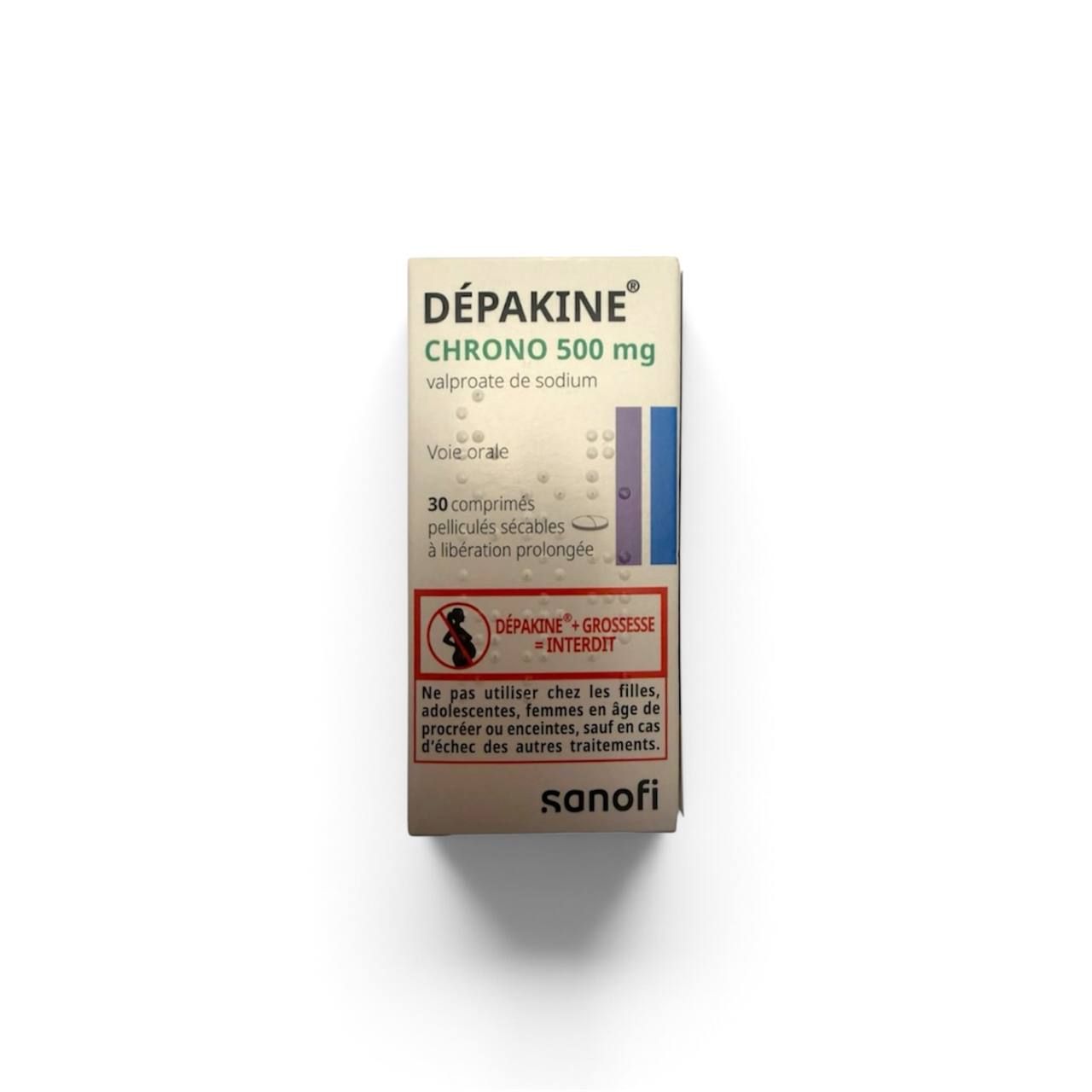
Depakine Chrono 500 mg (Sodium Valproate) 30 tab
59,00 €
Antiepileptic drug
In stock
Save this product for later
Customer reviews
Reviews only from verified customers
No reviews yet. You can buy this product and be the first to leave a review.
Depakine Chrono 500 mg (Sodium Valproate) 30 tab
Product Details
Depakine Chrono 500 mg (Sodium Valproate) 30 Prolonged-Release Tablets — Sanofi
Depakine Chrono is the original Sanofi prolonged-release formulation of sodium valproate — one of the most widely used antiepileptics in European practice. The Chrono matrix releases valproate gradually, smoothing blood levels across the day: fewer daily doses, smaller concentration peaks, and typically better tolerance than immediate-release forms. Valproate covers a uniquely broad spectrum of seizure types and is also a mood stabilizer in bipolar disorder management.
⚠️ Critical safety information — read before anything else
The pack carries an explicit regulatory warning (as printed: "DÉPAKINE + GROSSESSE = INTERDIT" — Depakine + pregnancy = forbidden):
- Contraindicated in pregnancy — valproate causes serious birth defects and developmental disorders in the child;
- Not for girls, adolescents and women of childbearing potential unless other treatments have failed and a Pregnancy Prevention Program is in place — this is a formal regulatory requirement (effective contraception + specialist supervision);
- Only in exceptional cases for women who can conceive, per the treating neurologist/psychiatrist's documented decision.
This is not a formality — valproate is one of the most strictly regulated medicines in Europe precisely because of this risk. If you are a woman who can become pregnant, discuss alternatives (lamotrigine, levetiracetam, oxcarbazepine) with your physician before considering valproate.
Why valproate holds its place in epilepsy treatment
- Broadest spectrum in the class — effective for generalized tonic-clonic, absence, myoclonic seizures and in Lennox-Gastaut-type syndromes: one molecule across seizure types where others specialize;
- Chrono matrix advantage — prolonged release smooths the concentration curve: typically twice-daily dosing instead of three times, lower peak-related side effects;
- Bipolar indication — established mood-stabilizer role in mania management;
- Decades of practice — among the longest-used antiepileptics with fully characterized long-term behavior.
Composition and form
- Active ingredient: sodium valproate 500 mg per prolonged-release tablet;
- Form: 30 prolonged-release film-coated tablets, oral route;
- Manufacturer: Sanofi (Europe).
How it is used
- Standard adult epilepsy dose: typically 500 mg twice daily, titrated per response (per neurologist);
- Swallow whole — do not crush or chew (prolonged-release matrix);
- Take with or without food, at consistent times;
- Never stop abruptly — withdrawal risks seizures; any discontinuation is a physician-planned taper;
- Dose and schedule are always determined by the treating physician; blood levels may be monitored.
Safety information
- Pregnancy prohibition — see the critical block above; Pregnancy Prevention Program applies;
- Liver monitoring — rare but serious hepatotoxicity; liver function tests during early treatment and periodically;
- Pancreatitis — rare; severe abdominal pain requires immediate medical attention;
- Common effects: weight gain, tremor, drowsiness, hair thinning — often dose-related and manageable;
- Interactions — valproate interacts with lamotrigine (dose reduction needed), aspirin and other highly protein-bound drugs;
- Women planning pregnancy on valproate must consult their neurologist before conception — plans change medications in advance.
FAQ — Frequently Asked Questions
Why is Depakine forbidden during pregnancy?
Valproate crosses the placenta and causes congenital malformations at significantly higher rates than other antiepileptics, plus long-term developmental and cognitive effects in children exposed in utero. European regulators (EMA) therefore restrict it: for women who can become pregnant it is prescribed only when other treatments failed, under a formal Pregnancy Prevention Program with contraception and specialist monitoring. This restriction protects patients — it is based on decades of documented outcomes.
What does "Chrono" mean and why does it matter?
Chrono is Sanofi's prolonged-release matrix: the tablet releases valproate gradually over the day instead of all at once. Practical benefits: typically twice-daily dosing instead of three times, smaller concentration peaks (fewer dose-related side effects like tremor or drowsiness), and steadier seizure control overnight. Do not crush the tablet — that destroys the release mechanism.
How is valproate different from lamotrigine or levetiracetam?
Valproate covers the broadest seizure spectrum in one molecule — that is its historical strength, especially for generalized epilepsies with multiple seizure types. Lamotrigine and levetiracetam have narrower (but overlapping) spectra with better tolerability profiles and far fewer restrictions for women of childbearing age. Modern practice often prefers the alternatives where they work; valproate remains where its broad spectrum is genuinely needed. The choice is a neurologist's decision based on your epilepsy type.
Can I drink alcohol while on Depakine?
Alcohol adds CNS depression on top of the antiepileptic and lowers the seizure threshold as it wears off — the combination undermines the very reason you take valproate. Occasional small amounts are a physician discussion; regular drinking during epilepsy therapy is not reasonable. The same applies to any antiepileptic.
I missed a dose — what now?
Take it as soon as you remember if the next scheduled dose is far away; skip it if the next dose is close — and never double up. Missing occasional doses happens; the goal is consistency, because fluctuating levels raise seizure risk. If doses are missed frequently, discuss reminder strategies or the Chrono form's convenience with your physician.
Ask a question or inquire about delivery to your country
You May Also Like


Gabapentine 300 mg 90 caps
Gabapentine 300 mg 90 caps
Remedy for neuropathic pain and convulsions
87,00 €

Display prices in:EUR

