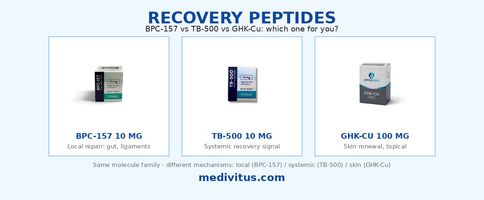
BPC-157, TB-500 and GHK-Cu are the three most discussed recovery peptides of 2026. They work through different mechanisms: BPC-157 acts locally (gut, ligaments, tendons), TB-500 works systemically via cell migration, GHK-Cu targets skin renewal through copper-dependent enzymes. They are frequently combined in research protocols. At Medivitus Pharma you can buy all three - original BioYgen and APEX BIO vials with bacteriostatic water for reconstitution.
Why recovery peptides are everywhere in 2026
Peptides have moved from research labs into wellness and beauty communities. Three names dominate the discussion: BPC-157 ("the Wolverine peptide"), TB-500 (the systemic repair protein fragment) and GHK-Cu (the copper beauty peptide). Each has a distinct biological story - and each answers a different question about recovery.
Important framing: these are cosmetic research peptides, not approved medicines. This guide explains what research literature says about each, without medical promises.
BPC-157: the local repair specialist
BPC-157 (Body Protection Compound) is a synthetic 15-amino-acid peptide derived from a protein found in human gastric juice. In research models it is associated with:
Gut protection
- the most studied area: gastric mucosa repair and inflammatory modulation;
Tendon and ligament repair
- localized connective tissue recovery in animal models;
Angiogenesis
- support of new blood vessel formation at injury sites;
NO-system modulation
- cytoprotective effects through nitric oxide pathways.
Its "local" character is why user protocols often target specific injuries (a knee, an elbow, the gut) rather than systemic effects. Typical research vials: 10 mg, reconstituted with 2-4 ml bacteriostatic water.
Buy BPC-157 BioYgen 10 mg ->
TB-500: the systemic repair signal
TB-500 is a synthetic fragment (amino acids 17-23) of Thymosin Beta-4 - a naturally occurring protein present in almost all human cells. Where BPC-157 is "local", TB-500 works systemically:
Cell migration
- TОІ4 promotes movement of cells to injury sites throughout the body;
Tissue remodeling
- associated with muscle, skin and connective tissue recovery in research models;
Anti-inflammatory profile
- studied for inflammation modulation;
Fewer injections
- typical user protocols run twice weekly (loading) then once weekly (maintenance), vs daily for BPC-157.
This systemic nature is why TB-500 and BPC-157 are so often paired: one signals repair across the body, the other focuses on the specific site.
Buy TB-500 BioYgen 10 mg ->
GHK-Cu: the copper beauty peptide
GHK-Cu is a copper-binding tripeptide naturally present in human plasma - discovered by Loren Pickart in 1973. Its story is different: it is primarily studied for skin and tissue renewal:
Collagen and elastin support
- studied in skin renewal research;
Copper delivery
- supports lysyl oxidase, a copper-dependent enzyme essential for tissue remodeling;
Anti-inflammatory profile
- studied for inflammation modulation;
Mostly topical
- unlike BPC-157/TB-500, GHK-Cu is most often used in skincare research (serums, microneedling) rather than injection.
Its 2026 popularity spike comes from beauty communities: GHK-Cu is a key ingredient in premium skincare research. Note: copper peptide solutions are photosensitive - protect reconstituted vials from light.
Buy GHK-Cu APEX BIO 100 mg ->
Quick comparison
Same molecule family? No - three different structures:
BPC-157
- 15 amino acids, gastric-derived, local repair focus, 10 mg vials, daily protocols;
TB-500
- TОІ4 fragment (7 amino acids), systemic cell migration, 10 mg vials, 2x/week protocols;
GHK-Cu
- tripeptide + copper, skin renewal focus, 100 mg vials, mostly topical use.
Can they be combined? In user and research protocols - yes: BPC-157 + TB-500 is the classic recovery pairing; GHK-Cu is usually run separately (topical) alongside injectable protocols.
Which one to choose? It depends on the question: gut and joint issues - BPC-157 focus; systemic recovery and fewer injections - TB-500; skin renewal and beauty research - GHK-Cu. Many users run BPC-157 + TB-500 together and add GHK-Cu topically.
Reconstitution: what every protocol needs
All three peptides come lyophilized (powder) and require reconstitution with bacteriostatic water (0.9% benzyl alcohol) - plain sterile water cannot keep a multi-dose vial safe between uses. The standard: 2-4 ml per 5-10 mg vial, 5-10 ml for 100 mg GHK-Cu vials.
Buy Bacteriostatic Water 30 ml ->
Storage: reconstituted peptides go in the refrigerator (+2...+8 C). GHK-Cu solutions additionally need light protection. Each peptide vial gets its own dilution - never mix reconstituted peptides.
Safety framing
These are cosmetic research peptides: not approved medicines, not evaluated by regulatory agencies for therapeutic use. User communities report good tolerability, and research literature describes mild profiles in animal models - but long-term human safety data are limited. Not for persons under 18, pregnant or breastfeeding women. Sterile technique during reconstitution and administration is essential.
FAQ
Can I take all three at once?
User protocols often combine BPC-157 + TB-500 (injectable) and run GHK-Cu topically in parallel. The three act on different pathways. Final protocol choices are made within user or practitioner guidance.
Which peptide is best for joints?
Research communities most often point to BPC-157 for localized joint/ligament focus, with TB-500 added systemically. GHK-Cu is not typically used for joint protocols.
Which one for skin?
GHK-Cu - it is the skin renewal peptide, mostly topical. BPC-157 and TB-500 are systemic recovery peptides, not skincare actives.
Why bacteriostatic water instead of sterile water?
Benzyl alcohol 0.9% prevents bacterial growth in a multi-dose vial between uses. Plain sterile water has no preservative and cannot keep a vial safe across several injections.