Glutathione: what science says about the master antioxidant
Why every cell needs glutathione, how levels decline with age, IV vs oral forms - and the honest answer on skin lightening claims.
Isotretinoin clears even severe acne that resisted everything else. But the dose decides how fast the course goes and how strong the side effects are. Here is how dermatologists actually choose between 10 mg and 20 mg.
TL;DR
Isotretinoin is the most effective medicine for severe or stubborn acne. Curacne (Pierre Fabre) is available in 10 mg and 20 mg soft capsules; both contain the same active ingredient, the difference is the dose per capsule. The right starting dose is calculated by weight and acne severity - typically 0.5 mg per kg of body weight per day - and only a dermatologist should set and adjust it. At Medivitus Pharma you can buy original Curacne with worldwide shipping from Europe.
What is isotretinoin?
Isotretinoin is a retinoid - a vitamin A derivative - that works where other acne treatments fail. It reduces the size and activity of the sebaceous glands, normalises skin shedding inside the follicle, and lowers inflammation and the bacteria that feed on sebum. Because it acts on all four causes of acne at once, dermatologists call it the most effective acne treatment available: studies show that up to 85% of patients achieve long-term clearance after one properly completed course.
The molecule has been used in clinical practice since the 1980s, first under the name Accutane, and today is sold worldwide under dozens of brand names - Curacne (France) being one of the most trusted European originals.
10 mg vs 20 mg: what is the real difference?
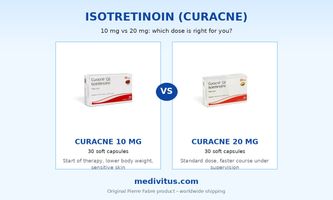
Both Curacne versions contain the same molecule. The difference is only the amount of isotretinoin in one capsule:
- a lower dose per capsule. Used for starting therapy, lower body weight, mild-to-moderate persistent acne, or when side effects need to be kept to a minimum.
- the standard workhorse dose. Most adults are prescribed 20 mg per day or split across two capsules, depending on the dermatologist's plan.
The daily dose is calculated individually - roughly 0.5 mg per kg of body weight at the start of the course, with the option to increase later. For a 60 kg patient this means about 30 mg per day, which is why the doctor may combine one 20 mg and one 10 mg capsule, or use two 20 mg capsules every other day at lower weights.
Research comparing low-dose and standard-dose schemes shows a consistent pattern: lower daily doses cause milder skin dryness and fewer other side effects, but the course lasts longer and relapse is somewhat more frequent. Higher doses finish the course faster but with more pronounced side effects. The "best" dose is the one chosen by the dermatologist for a specific patient, not the one recommended on the internet.
How to choose between 10 mg and 20 mg
First course, moderate acne, sensitive skin:
dermatologists often start at 10-20 mg per day and titrate.
Severe nodular acne:
usually a standard or higher weight-based dose under close supervision.
Side effects appear during the course:
the doctor may reduce the daily dose by switching to 10 mg capsules.
Maintenance or low-dose long course:
10 mg schemes are popular for patients who cannot tolerate higher doses.
Never change the dose yourself. The cumulative dose over the whole course matters as much as the daily one, and both are controlled by the physician.
How the course works
A typical course lasts 4-8 months and aims at a cumulative dose of 120-150 mg per kg of body weight. Blood tests (lipids, liver enzymes) are checked before the start and during the course. Isotretinoin is taken with food - fatty meals improve absorption.
Strictly contraindicated in pregnancy: reliable contraception is mandatory during the course and for at least one month after it, for all patients who can become pregnant. This rule is absolute, and dermatologists check it at every visit.
Side effects: what to expect
The most common effect is dryness - of lips, skin and eyes. Lip balm and moisturiser become daily essentials. Other possible effects include increased sensitivity to sunlight, temporary muscle aches after exercise, and, rarely, mood changes - any unusual emotional state should be reported to the doctor immediately. Most side effects are dose-dependent and reversible after the course.
FAQ
Is Curacne the same as Roaccutane?
Yes - the same active molecule (isotretinoin) by a different manufacturer. Curacne is the French original by Pierre Fabre; Roaccutane is sold in other markets. The difference is packaging, price and availability, not the molecule.
Which dose gives better results: 10 mg or 20 mg?
Results depend on the total accumulated dose, not on the number in one capsule. Both doses can clear acne completely - the schemes differ in speed and side-effect intensity.
Can I take 10 mg in the morning and 20 mg in the evening?
Only if the dermatologist prescribed exactly this combination. Self-made schemes are the main cause of side effects and relapse.
Do I need a prescription?
Yes, isotretinoin is a prescription-only medicine. A dermatologist should confirm the diagnosis, choose the dose and monitor blood tests.
Is Curacne available without prescription at Medivitus?
We supply original Curacne worldwide, but strongly recommend medical supervision: isotretinoin requires monitoring regardless of the source of purchase.
Ask a question or inquire about delivery to your country: